Test KCNA Topics Pdf - Valid KCNA Test Cost
Wiki Article
BTW, DOWNLOAD part of TopExamCollection KCNA dumps from Cloud Storage: https://drive.google.com/open?id=1QeXf9VyTxbzIYUG4Rsnnu-mpkHmSkDHb
To do this the Linux Foundation KCNA certification exam candidates can stay updated and competitive and get a better career opportunity in the highly competitive market. So we can say that with Kubernetes and Cloud Native Associate KCNA certificate you can not only validate your expertise but also put your career on the right track.
Linux Foundation KCNA certification is recognized globally as a mark of excellence in cloud-native computing. It is an industry-recognized certification that demonstrates a candidate's expertise in Kubernetes and cloud-native technologies. Kubernetes and Cloud Native Associate certification is ideal for individuals who are seeking to enhance their career prospects in the field of cloud-native computing.
The Kubernetes and Cloud Native Associate certification exam is designed for individuals who have basic knowledge of Linux administration and the ability to work with command-line interfaces. KCNA Exam covers a broad range of topics, including containerization, container orchestration, Kubernetes networking, storage, security, and troubleshooting. Successful completion of KCNA exam demonstrates that the candidate has the skills to run and manage Kubernetes clusters and deploy cloud-native applications.
100% Pass Quiz KCNA - Professional Test Kubernetes and Cloud Native Associate Topics Pdf
The TopExamCollection product here is better, cheaper, higher quality and unlimited for all time; kiss the days of purchasing multiple Linux Foundation copyright repeatedly, or renewing KCNA training courses because you ran out of time. Now you can learn KCNA skills and theory at your own pace and anywhere you want with top of the KCNA copyright, you will find it's just like a pice a cake to pass KCNAexam.
The Kubernetes and Cloud Native Associate certification exam covers a wide range of topics, including containerization, Kubernetes architecture, deployment, and management. It also covers other cloud-native technologies such as Prometheus, Helm, and Istio. This means that individuals who copyright will have a solid understanding of the fundamentals of cloud-native technologies and Kubernetes.
Linux Foundation Kubernetes and Cloud Native Associate Sample Questions (Q181-Q186):
NEW QUESTION # 181
What factors influence the Kubernetes scheduler when it places Pods on nodes?
- A. Node taints, node level, and Pod priority.
- B. Pod labels, node labels, and request labels.
- C. Pod priority, container command, and node labels.
- D. Pod memory requests, node taints, and Pod affinity.
Answer: D
Explanation:
The Kubernetes scheduler chooses a node for a Pod by evaluating scheduling constraints and cluster state.
Key inputs include resource requests (CPU/memory), taints/tolerations, and affinity/anti-affinity rules.
Option A directly names three real, high-impact scheduling factors-Pod memory requests, node taints, and Pod affinity-so A is correct.
Resource requests are fundamental: the scheduler must ensure the target node has enough allocatable CPU
/memory to satisfy the Pod's requests. Requests (not limits) drive placement decisions. Taints on nodes repel Pods unless the Pod has a matching toleration, which is commonly used to reserve nodes for special workloads (GPU nodes, system nodes, restricted nodes) or to protect nodes under certain conditions. Affinity and anti-affinity allow expressing "place me near" or "place me away" rules-e.g., keep replicas spread across failure domains or co-locate components for latency.
Option B includes labels, which do matter, but "request labels" is not a standard scheduler concept; labels influence scheduling mainly through selectors and affinity, not as a direct category called "request labels." Option C mixes a real concept (taints, priority) with "node level," which isn't a standard scheduling factor term. Option D includes "container command," which does not influence scheduling; the scheduler does not care what command the container runs, only placement constraints and resources.
Under the hood, kube-scheduler uses a two-phase process (filtering then scoring) to select a node, but the inputs it filters/scores include exactly the kinds of constraints in A. Therefore, the verified best answer is A.
=========
NEW QUESTION # 182
What is scheduling in Kubernetes
- A. Determining when to execute a cron-job
- B. Setting a time for automated tasks
- C. Joining a new nodes to the clusters
- D. Assigning pods to nodes
Answer: D
Explanation:
https://kubernetes.io/docs/concepts/scheduling-eviction/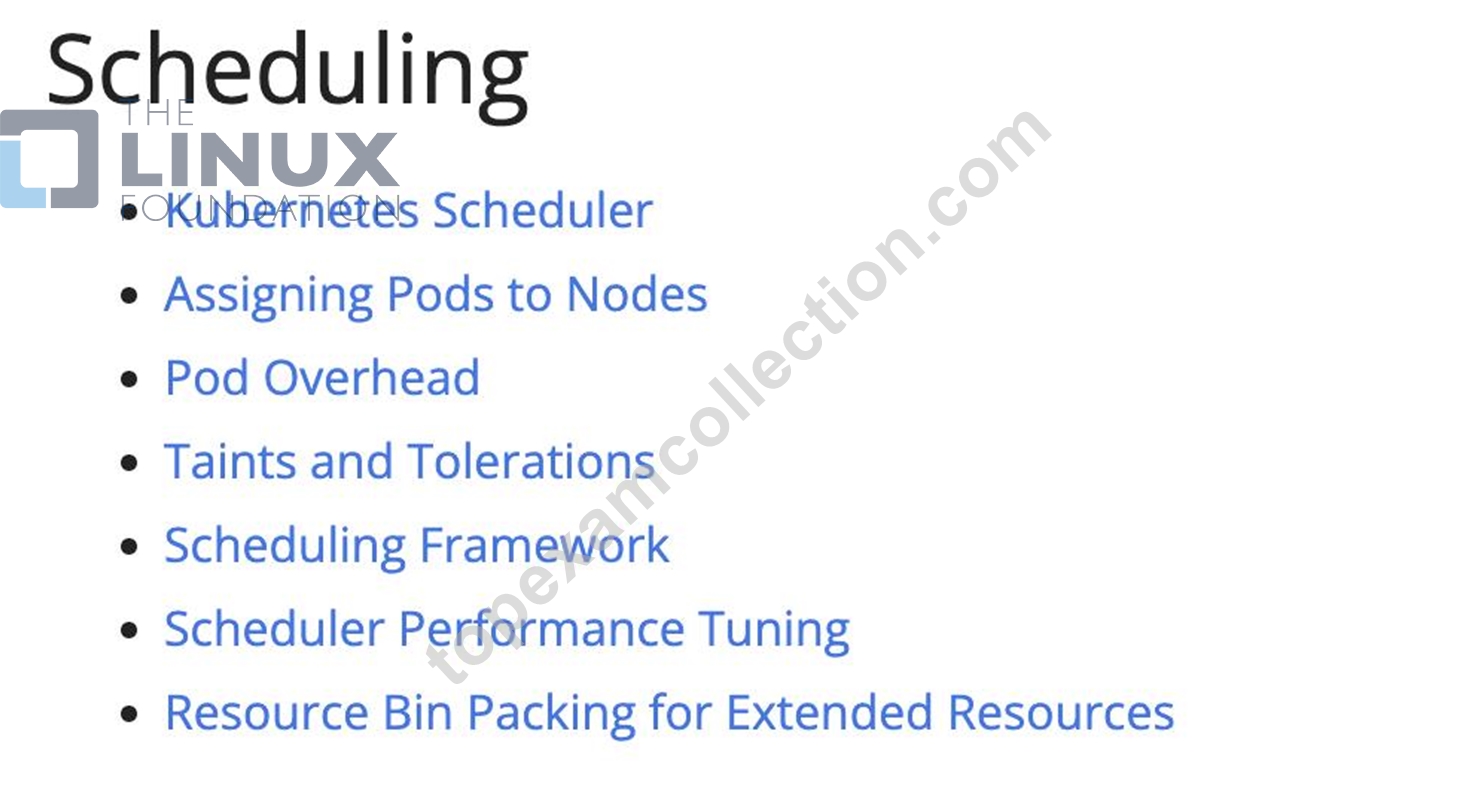
NEW QUESTION # 183
Which of the following resources helps in managing a stateless application workload on a Kubernetes cluster?
- A. DaemonSet
- B. kubectl
- C. Deployment
- D. StatefulSet
Answer: C
Explanation:
The correct answer is D: Deployment. A Deployment is the standard Kubernetes controller for managing stateless applications. It provides declarative updates, replica management, and rollout/rollback functionality.
You define the desired state (container image, environment variables, ports, replica count) in the Deployment spec, and Kubernetes ensures the specified number of Pods are running and updated according to strategy (RollingUpdate by default).
Stateless workloads are ideal for Deployments because each replica is interchangeable. If a Pod dies, a new one can be created anywhere; if traffic increases, replicas can be increased; if you need to update the app, a new ReplicaSet is created and traffic shifts gradually to new Pods. Deployments integrate naturally with Services for stable networking and load balancing.
Why the other options are incorrect:
* A DaemonSet ensures one Pod per node (or selected nodes). It's for node-level agents, not generic stateless service replicas.
* A StatefulSet is for workloads needing stable identity, ordered rollout, and persistent storage per replica (databases, quorum systems). That's not the typical stateless app case.
* kubectl is a CLI tool; it doesn't "manage" workloads as a controller resource.
In real cluster operations, almost every stateless microservice is represented as a Deployment plus a Service (and often an Ingress/Gateway for edge routing). Deployments also support advanced delivery patterns (maxSurge/maxUnavailable tuning) and easy integration with HPA for horizontal scaling. Because the question is specifically "managing a stateless application workload," the Kubernetes resource designed for that is clearly the Deployment.
=========
NEW QUESTION # 184
What is the purpose of the CRI?
- A. Provide an interface allowing Kubernetes to support pluggable container runtimes.
- B. Allow the definition of dynamic resource criteria across containers.
- C. To provide runtime integration control when multiple runtimes are used.
- D. Support container replication and scaling on nodes.
Answer: A
Explanation:
The Container Runtime Interface (CRI) exists so Kubernetes can support pluggable container runtimes behind a stable interface, which makes C correct. In Kubernetes, the kubelet is responsible for managing Pods on a node, but it does not implement container execution itself. Instead, it delegates container lifecycle operations (pull images, create pod sandbox, start/stop containers, fetch logs, exec/attach streaming) to a container runtime through a well-defined API. CRI is that API contract.
Because of CRI, Kubernetes can run with different container runtimes-commonly containerd or CRI-O-without changing kubelet core logic. This improves portability and keeps Kubernetes modular: runtime innovation can happen independently while Kubernetes retains a consistent operational model. CRI is accessed via gRPC and defines the services and message formats kubelet uses to communicate with runtimes.
Option B is incorrect because replication and scaling are handled by controllers (Deployments/ReplicaSets) and schedulers, not by CRI. Option D is incorrect because resource criteria (requests/limits) are expressed in Pod specs and enforced via OS mechanisms (cgroups) and kubelet/runtime behavior, but CRI is not "for defining dynamic resource criteria." Option A is vague and not the primary statement; while CRI enables runtime integration, its key purpose is explicitly to make runtimes pluggable and interoperable.
This design became even more important as Kubernetes moved away from Docker Engine integration (dockershim removal from kubelet). With CRI, Kubernetes focuses on orchestrating Pods, while runtimes focus on executing containers. That separation of responsibilities is a core container orchestration principle and is exactly what the question is testing.
So the verified answer is C.
NEW QUESTION # 185
Which item is a Kubernetes node component?
- A. etcd
- B. kubectl
- C. kube-proxy
- D. kube-scheduler
Answer: C
Explanation:
A Kubernetes node component is a component that runs on worker nodes to support Pods and node-level networking/operations. Among the options, kube-proxy is a node component, so C is correct.
kube-proxy runs on each node and implements parts of the Kubernetes Service networking model. It watches the API server for Service and endpoint updates and then programs node networking rules (iptables/IPVS, or equivalent) so traffic sent to a Service IP/port is forwarded to one of the backend Pod endpoints. This is essential for stable virtual IPs and load distribution across Pods.
Why the other options are not node components:
* kube-scheduler is a control plane component; it assigns Pods to nodes but does not run on every node as part of node functionality.
* kubectl is a client CLI tool used by humans/automation; it is not a cluster component.
* etcd is the control plane datastore; it stores cluster state and is not a per-node workload component.
Operationally, kube-proxy can be replaced by some modern CNI/eBPF dataplanes, but in classic Kubernetes architecture it remains the canonical node-level component for Service rule programming. Understanding which components are node vs control plane is key for troubleshooting: node issues involve kubelet/runtime
/kube-proxy/CNI; control plane issues involve API server/scheduler/controller-manager/etcd.
So, the verified node component in this list is kube-proxy (C).
=========
NEW QUESTION # 186
......
Valid KCNA Test Cost: https://www.topexamcollection.com/KCNA-vce-collection.html
- Actual Linux Foundation KCNA Practice Test - Quick Test Preparation Tips ???? Search on ➡ www.vce4dumps.com ️⬅️ for ➥ KCNA ???? to obtain exam materials for free download ????KCNA Simulated Test
- Pass Guaranteed 2026 Linux Foundation KCNA: Updated Test Kubernetes and Cloud Native Associate Topics Pdf ???? Enter ➠ www.pdfvce.com ???? and search for ➥ KCNA ???? to download for free ????Download KCNA Pdf
- Hot Test KCNA Topics Pdf | High Pass-Rate Linux Foundation KCNA: Kubernetes and Cloud Native Associate 100% Pass ???? Easily obtain ➡ KCNA ️⬅️ for free download through [ www.exam4labs.com ] ◀Official KCNA Practice Test
- Hot Test KCNA Topics Pdf | High Pass-Rate Linux Foundation KCNA: Kubernetes and Cloud Native Associate 100% Pass ???? Search for ☀ KCNA ️☀️ and download it for free on 《 www.pdfvce.com 》 website ✔️Download KCNA Pdf
- HOT Test KCNA Topics Pdf - Latest Linux Foundation Kubernetes and Cloud Native Associate - Valid KCNA Test Cost ???? Download ▛ KCNA ▟ for free by simply entering ▷ www.vceengine.com ◁ website ????KCNA New copyright Free
- Reliable KCNA Test Labs ???? KCNA Exam Duration ???? New KCNA Exam Guide ↙ Search for ⇛ KCNA ⇚ on ▷ www.pdfvce.com ◁ immediately to obtain a free download ????Reliable KCNA Test Labs
- Testking KCNA Learning Materials ???? KCNA Simulated Test ✋ KCNA Demo Test ???? Search for 《 KCNA 》 on ➤ www.troytecdumps.com ⮘ immediately to obtain a free download ↕KCNA Simulated Test
- Pass Guaranteed Linux Foundation - Valid KCNA - Test Kubernetes and Cloud Native Associate Topics Pdf ???? Search for { KCNA } on ⮆ www.pdfvce.com ⮄ immediately to obtain a free download ????New KCNA Exam Guide
- Pass Guaranteed Linux Foundation - Valid KCNA - Test Kubernetes and Cloud Native Associate Topics Pdf ???? Download 《 KCNA 》 for free by simply entering ➽ www.dumpsquestion.com ???? website ????KCNA New copyright Free
- Pass-Sure KCNA – 100% Free Test Topics Pdf | Valid KCNA Test Cost ???? ▛ www.pdfvce.com ▟ is best website to obtain “ KCNA ” for free download ????Online KCNA Training
- 2026 Linux Foundation Test KCNA Topics Pdf - Realistic Test Kubernetes and Cloud Native Associate Topics Pdf 100% Pass Quiz ???? The page for free download of ▶ KCNA ◀ on ▷ www.dumpsquestion.com ◁ will open immediately ????Real KCNA Exam Questions
- annienspi007912.wikiconversation.com, albertgbzk931884.wikimillions.com, vinnyuwqd756459.bloggerchest.com, jemimaqfot915289.ourcodeblog.com, bookmarkja.com, setbookmarks.com, aadampqgj461442.smblogsites.com, bookmarkindexing.com, jonasxkhb048375.glifeblog.com, bookmarkfriend.com, Disposable vapes
P.S. Free 2026 Linux Foundation KCNA dumps are available on Google Drive shared by TopExamCollection: https://drive.google.com/open?id=1QeXf9VyTxbzIYUG4Rsnnu-mpkHmSkDHb
Report this wiki page